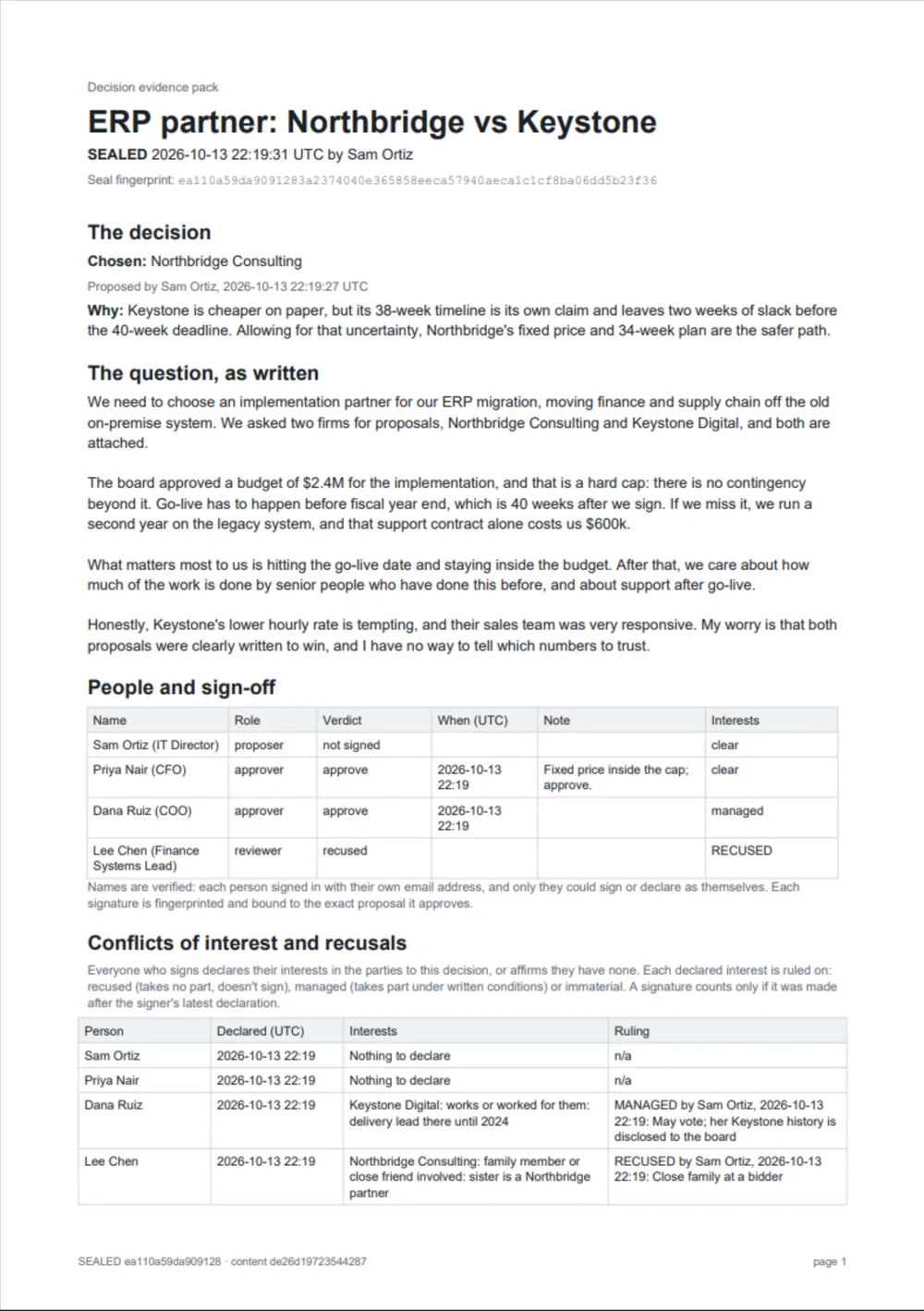
A language model is good at reading messy writing and terrible at arithmetic it can't show. So Xybernetex uses each for what it's good at.
The AI turns your writing into a model, and every number it proposes has to quote its source. Then plain, deterministic code does the decision analysis:
the same methods taught in decision science and operations research, run the same way every time.
Multi-attribute utility
Your priorities, as weights you can see
V(option) = Σ wᵢ · sᵢ / Σ wᵢ sᵢ ∈ [0, 10]
Each option is scored on every criterion you locked, and the scores are combined with the weights you chose. When the outcome is money, the model evaluates the formulas directly instead: cost, revenue, penalties.
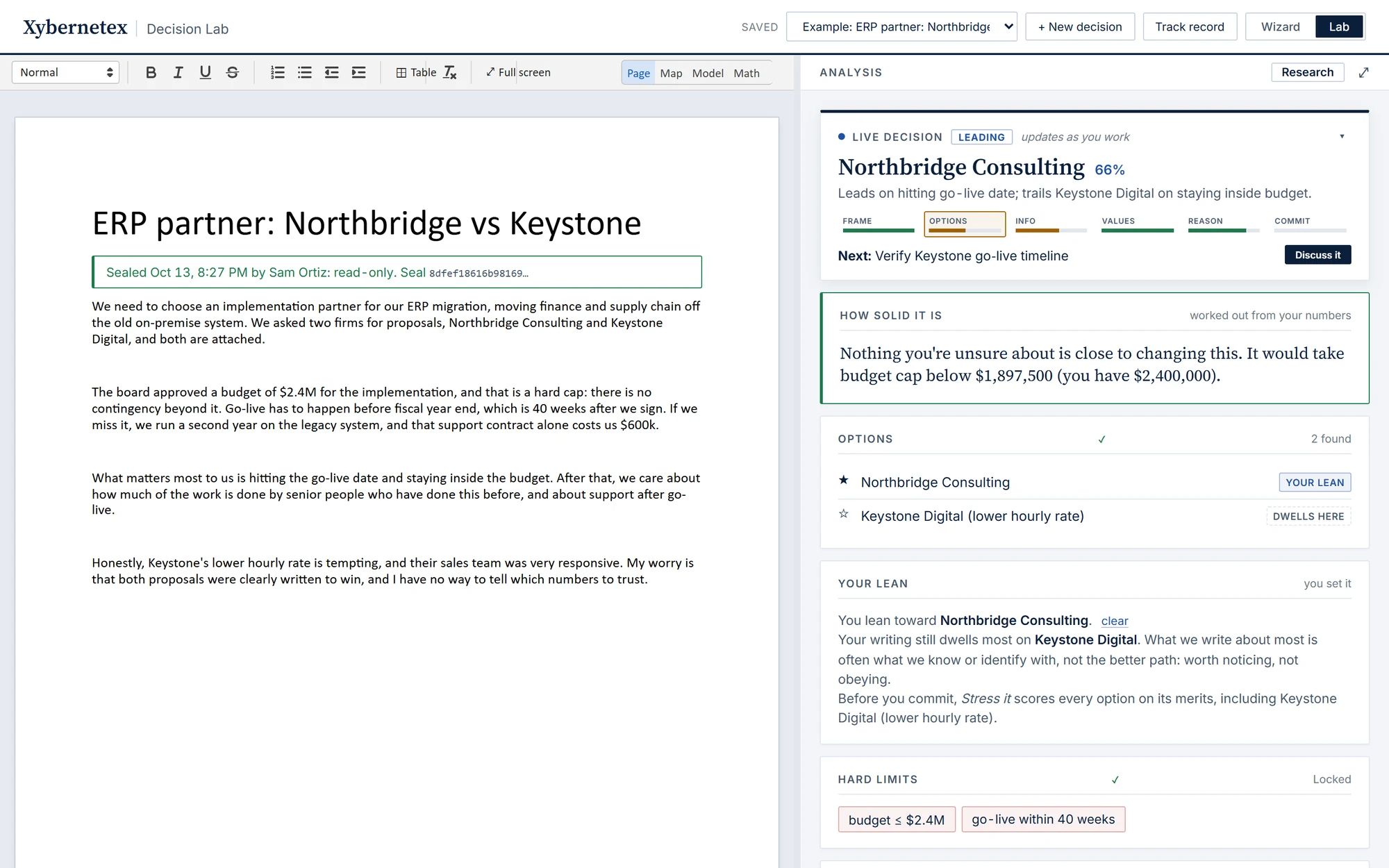
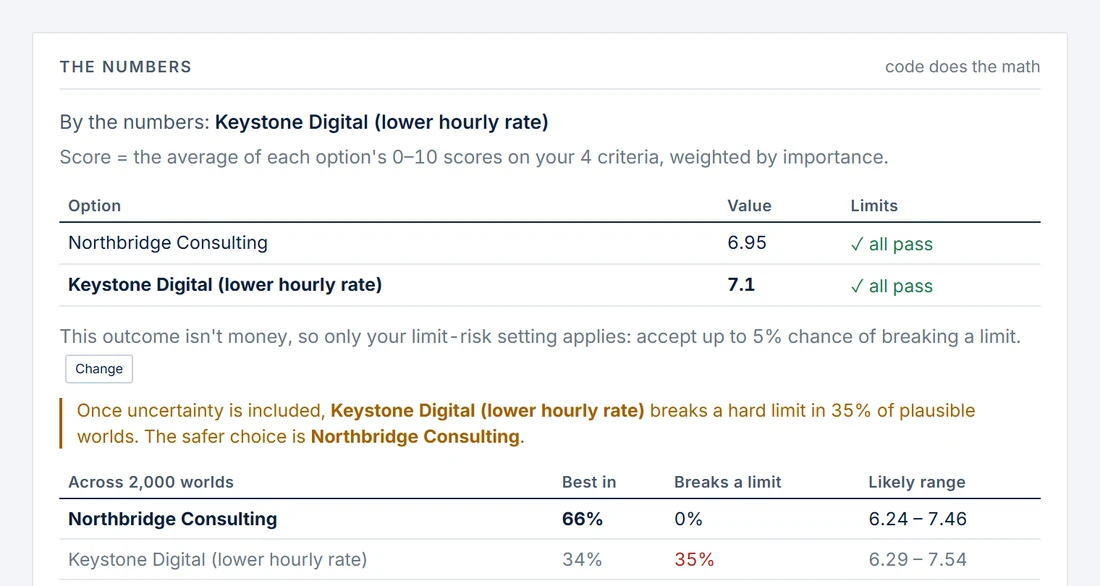
In the example: four criteria; on the point estimates, Keystone 7.1, Northbridge 6.95.
Monte Carlo simulation
2,000 plausible worlds, not one guess
xᵢ ~ Triangular(low, stated, high) + a point mass at the stated value
Every uncertain input is sampled from its plausible range. A vendor's claim is treated as the favourable end of that range, widened 25% in the direction that's worse for them, until someone verifies it. The random seed is fixed, so the answer is reproducible.
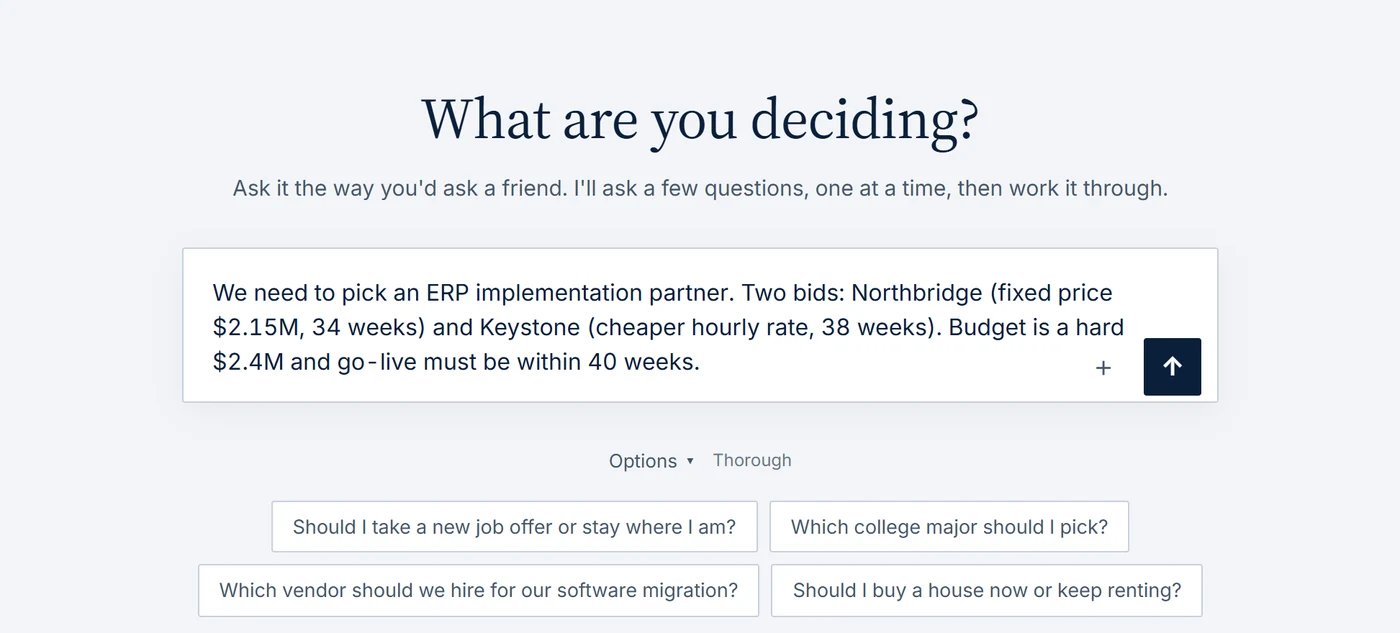
In the example: Keystone's "38 weeks" is sampled from 34 to 47.5 weeks.
Chance constraints
Survive first, then optimise
eligible ⇔ P(breaks a hard limit) ≤ α α = 5% by default
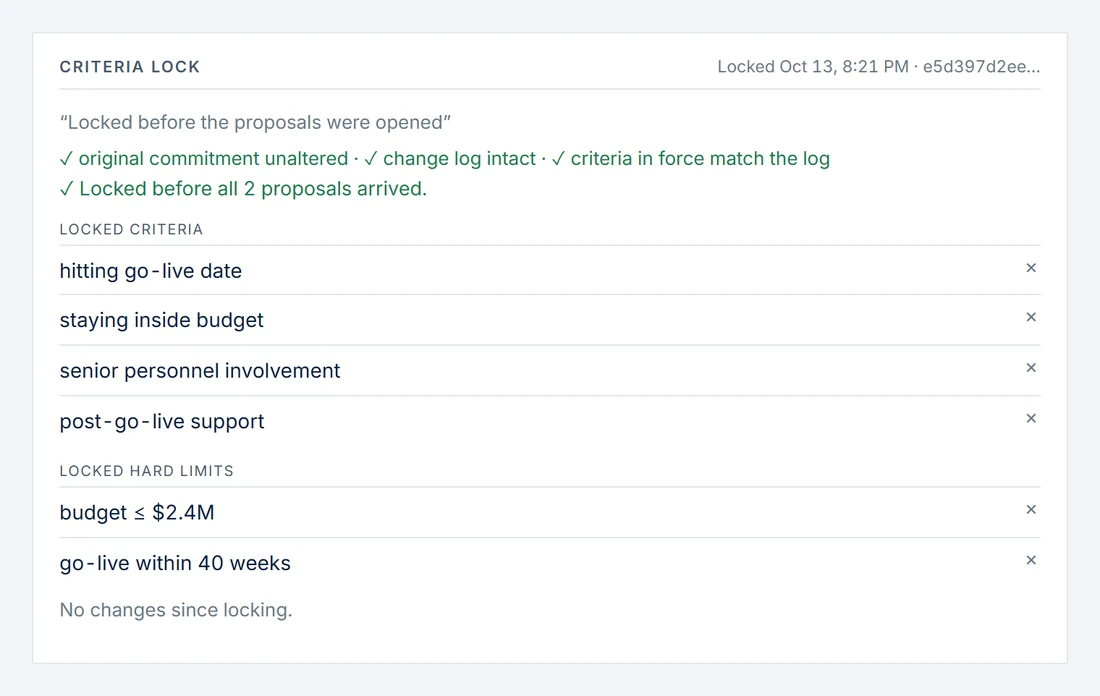
A hard limit is a limit, not a preference. An option that breaks the budget or the deadline in more than α of the simulated worlds is out, however good its average looks. You set α.
In the example: Keystone breaks a limit in 35% of worlds, Northbridge in 0%.
Risk attitude
Certainty equivalents, not just averages
CE = −R · ln 𝔼[ e−Y/R ] u(y) = 1 − e−y/R
When money is at stake, a spread of outcomes is worth less than its average to anyone who can't absorb the downside. Your risk tolerance R sets how much less, using exponential utility. Leave it blank and you're risk-neutral.
It answers: what sure amount would you swap this gamble for?
Value of information
What's worth checking, in money or points
EVPI = 𝔼[ maxa U(a, θ) ] − maxa 𝔼[ U(a, θ) ]
How much better you'd decide if you knew an input before choosing. It's computed for everything at once (EVPI), for each input (by deciding separately within slices of its range), and for groups of inputs (the regression method of Strong, Oakley & Brennan).
Research goes where it can change the answer.
In the example: perfect knowledge would add at most 0.19 points on the 0–10 score, a ceiling on what research is worth.
Threshold analysis
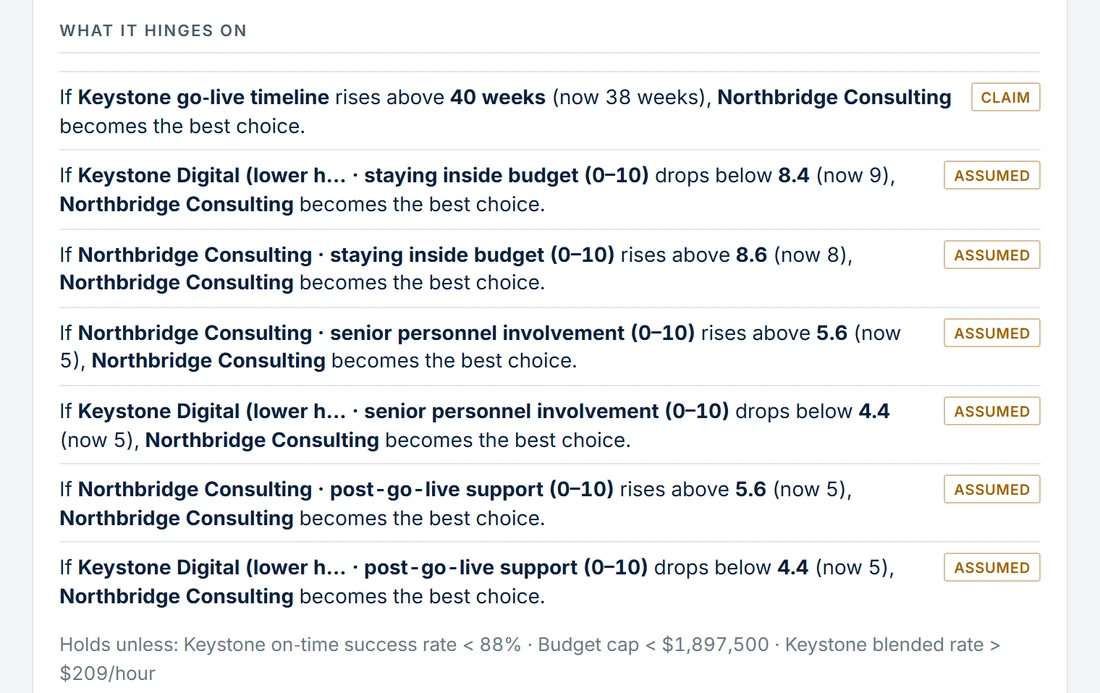
The exact point where the answer flips
find x* such that argmaxa V(a | xᵢ = x*) changes (bisection)
For each input, the code searches its range and pins down the value at which the best option changes. That's "what would change your mind": a specific number to watch, not a vague confidence score.
In the example: if Keystone's timeline goes past 40 weeks, Northbridge wins outright.
Robustness across viewpoints
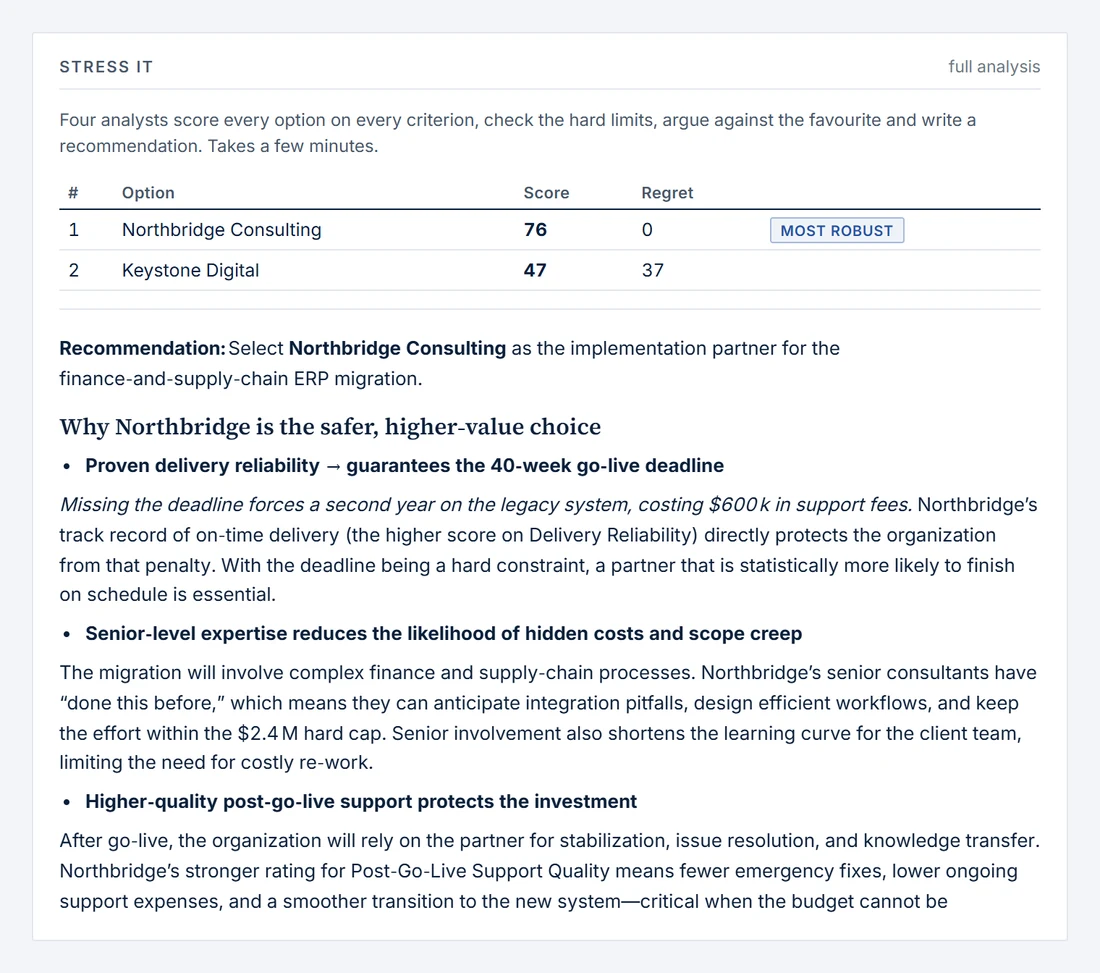
Pareto dominance and minimax regret
regret(a, p) = maxb Up(b) − Up(a)
robust = argmina maxp regret(a, p)
Four analysts (operator, quant, contrarian, steward) each score every option. Each viewpoint is treated as a possible state of the world. The most robust option is the one whose worst-case regret across them is smallest. Dominated options are flagged.
In the example: Northbridge is the consensus leader and the most robust.
Provenance and reproducibility
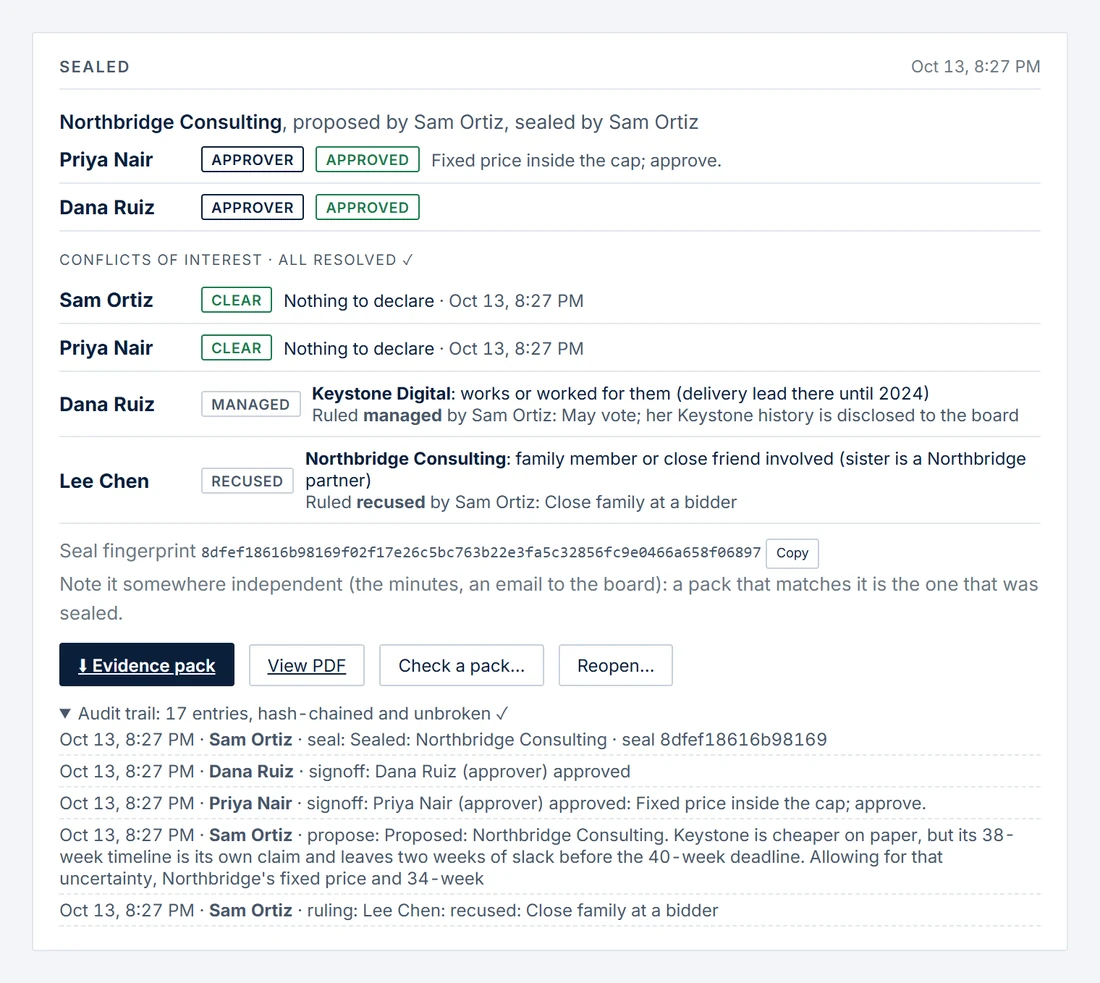
Every number traced, every result recomputable
fingerprint = SHA-256( canonical inputs ) seed = 7
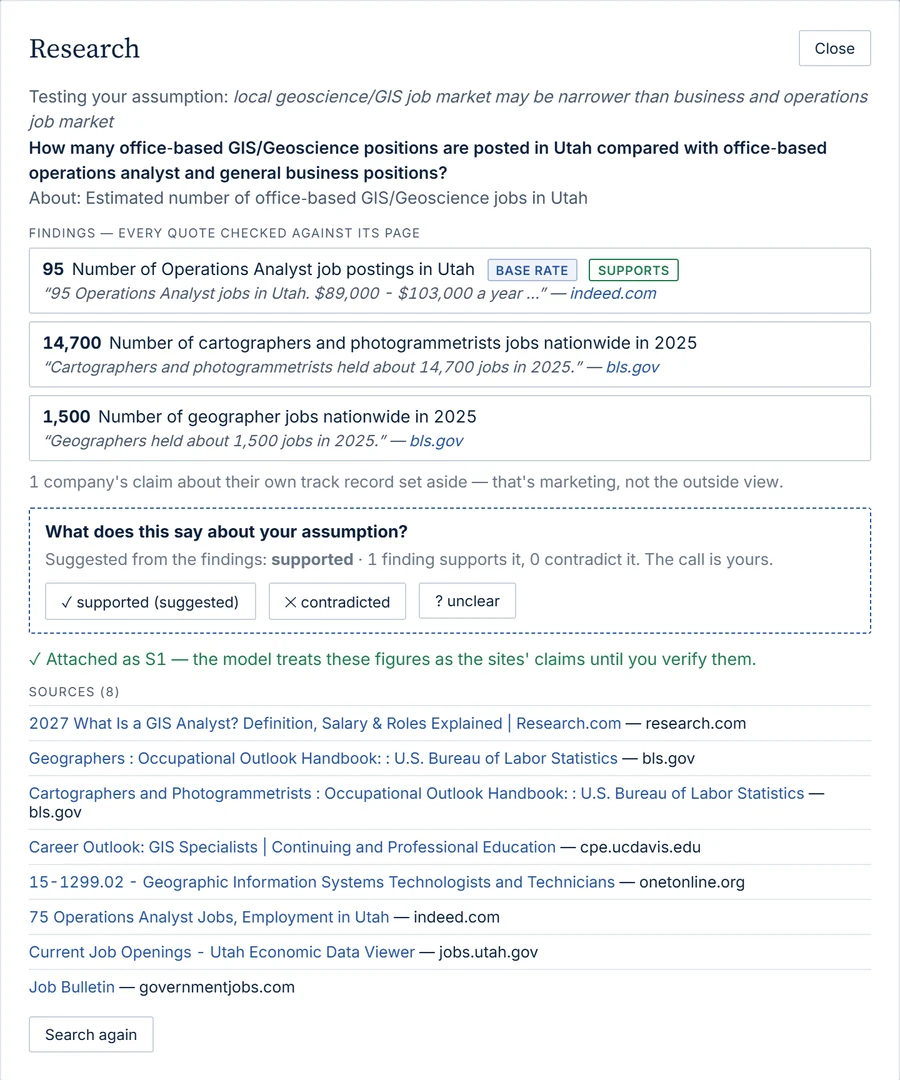
Each figure is checked against the exact quote it came from, and tagged as a fact, a claim, a verified claim or an assumption. The record stores the model, the inputs and the seed, so anyone can recompute it years later and get an identical fingerprint.
It answers: where did this number come from, and has anything changed since?
Grounded in standard decision analysis: multi-attribute utility theory (Keeney & Raiffa), expected value of perfect and partial information (Raiffa & Schlaifer; Strong, Oakley & Brennan, 2014), chance-constrained optimisation (Charnes & Cooper), and minimax regret (Savage).